How should you deal with ground slope and the placement of outdoor furniture?
When placing furniture, the ground surface is very important.
If there is a slope, it's important to determine how much slope there is and whether special measures need to be taken.
To establish this, we explain the following.
What do we mean by the term "slope"?
Slope is the incline of a terrain, floor or paved surface. This difference in height may have been deliberately created (for example, in paving, to ensure good water drainage) or may occur naturally in the terrain due to its location or ground conditions.
Why do you need to take slope into account when placing furniture?
With a slope of 2%, the terrain drops by 2 cm per metre. Across the width of a bench (e.g. 1,8 m), that already amounts to a difference of almost 3,6 cm.
If slope is not taken into account, this can result in a bench seat that isn't level, or, for example, a tilted planter. It also leads to uneven loading of the furniture on one side, which isn't good for its lifespan.

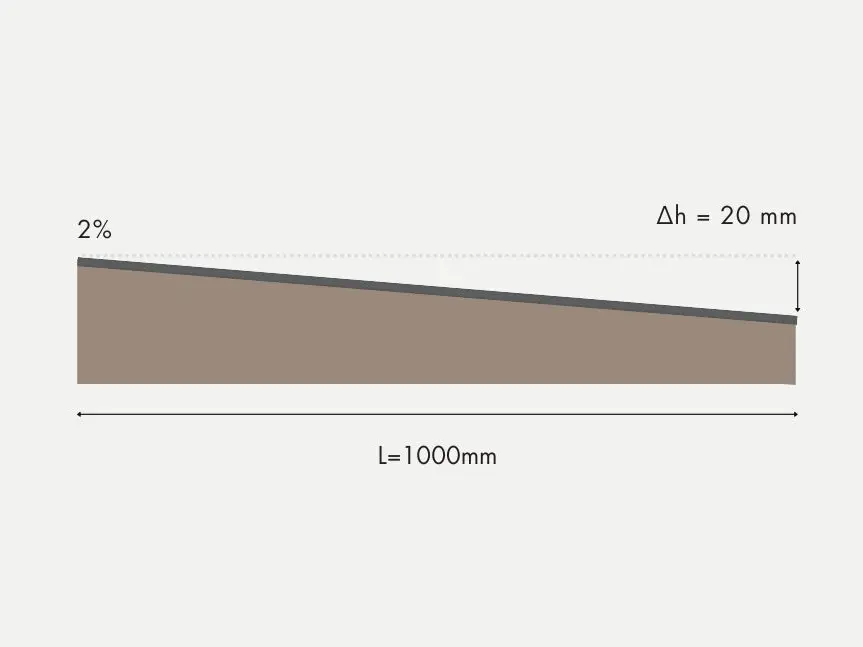
What should you do with a sloping site?
For a slope greater than 1–2% per metre (1–2 cm per metre), we're happy to discuss which solution is needed for the specific product.
We can resolve the difference in height in several ways, such as:
- Levelling using a concrete foundation or adjustable foot
- Adapted frame or adapted adjustable feet Raising/levelling the ground (sand, base layer)
- Installing a concrete foundation or footings
If there is slope in the terrain, it may be advisable to have the site digitally surveyed. If in doubt, we recommend having a level survey carried out before placing an order. If a DWG file with the level differences in the terrain is already available, we can use this file to help plan the placement of the street furniture.
Check the installation guidelines
Installation guidelines are provided for all benches/picnic sets, showing the space available below ground level. For planters, the length of the adjustable feet is stated. This allows you to determine whether the standard version offers sufficient space to accommodate the difference in level.
Questions on this topic?
Contact us for tailored advice.
Related questions
Yes, all planters can be moved with a forklift (or another vehicle with a fork lift).
Choosing appropriate seating goes beyond placing a bench somewhere. Several factors come into play to reach a good decision where you make smart investments.
To achieve maximum return for public spaces, we would like to help you on your way with explanations and a handy checklist.
Yes, we do. When ordering, we always provide a standard recommendation for the most suitable concrete foundation for the chosen street furniture.
If this foundation does not fit the situation on site, we look together at which foundation is really suitable. This usually depends on the ground, possible underground pipes, or other circumstances.
A deposit bracket, also known as a deposit holder, is a steel attachment that is fixed to a waste bin. It allows passersby to leave empty deposit bottles and cans so that others can collect and return them in a dignified way. This system helps reduce litter and promotes recycling.
Grijsen’s deposit holder is designed with a universal mounting system, making it easy to attach to the side of almost any public waste bin. Follow the steps below to correctly install the holder on a Grijsen waste bin.
At Grijsen, we primarily distinguish between two different placement methods relative to the ground level: mounting on ground level or mounting below ground level.